Psilocybe semilanceata
Liberty cap
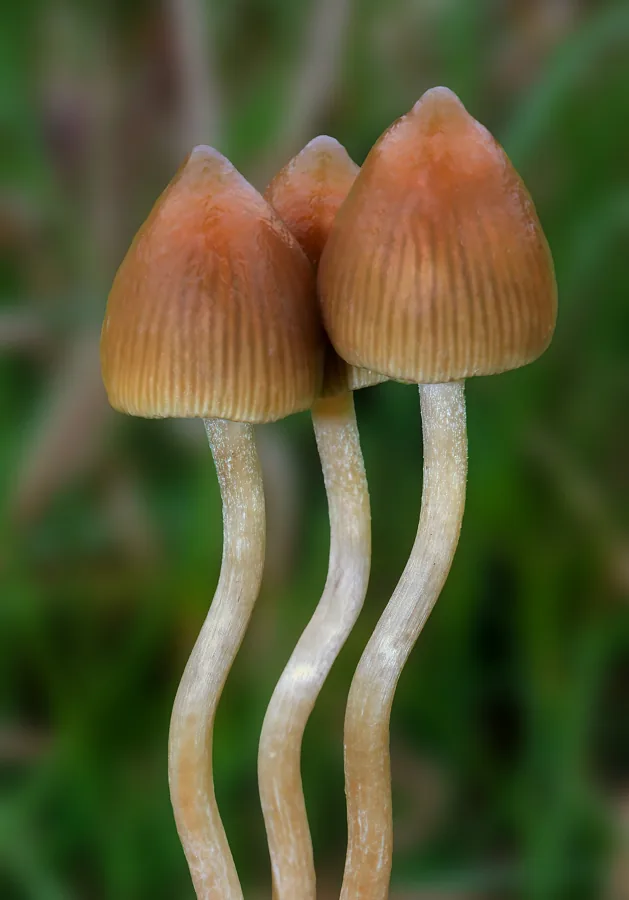
Small grassland species with a sharply pointed cap; one of the most potent wild Psilocybe.
Regional status: Widespread native of European grassland; also present in New Zealand
- Cap
- Conical to bell-shaped, 5-25 mm, with a distinct pointed nipple (umbo); olive to pale buff, hygrophanic, often with a separable gelatinous pellicle.
- Gills
- Narrow, adnexed, pale grey darkening to purple-black as the spores mature.
- Stem
- Very slender, 40-100 mm, wavy, pale cream, often bluing at the base.
- Flesh
- Thin and membranous.
- Spore print
- Dark purple-brown
- Habitat
- Damp, unimproved grassland and pasture, growing from buried grass roots and never directly on dung.
- Distribution
- Widespread across northern Europe, the Pacific Northwest, New Zealand, Chile and Tasmania.
- Season
- September to November after cool, wet weather.
- Bruising
- Blue-green at the stem base when handled or with age.
- Odour
- Faintly farinaceous.
- Potency
- Potent
Key features
- ▪Pointed nipple on the cap apex
- ▪Separable gelatinous cap skin
- ▪Very thin wavy stem
- ▪Grows from grass roots, not dung
Field tests
- Take a spore print: must be dark purple-brown
- Peel the cap skin - it should come away as an elastic film
- Scratch the stem base and wait a minute for blue
Edibility
Contains psilocybin. Illegal to possess in most countries.
Confused with Panaeolina foenisecii and small Conocybe. Conocybe filaris in the same lawns is deadly.
Lookalikes
Fruits in the same grass. It has a rusty-brown spore print and a movable ring, and never blues. A rusty print means stop.
Shares the same lawns. Foenisecii has a dark brown (not purple-black) spore print, no pointed nipple, no separable cap skin and never blues.
Photo and feature-based identification is probabilistic. Never consume a wild mushroom on the basis of an app result — confirm with an experienced mycologist.