Psilocybin-containingHymenogastraceaeAustralia
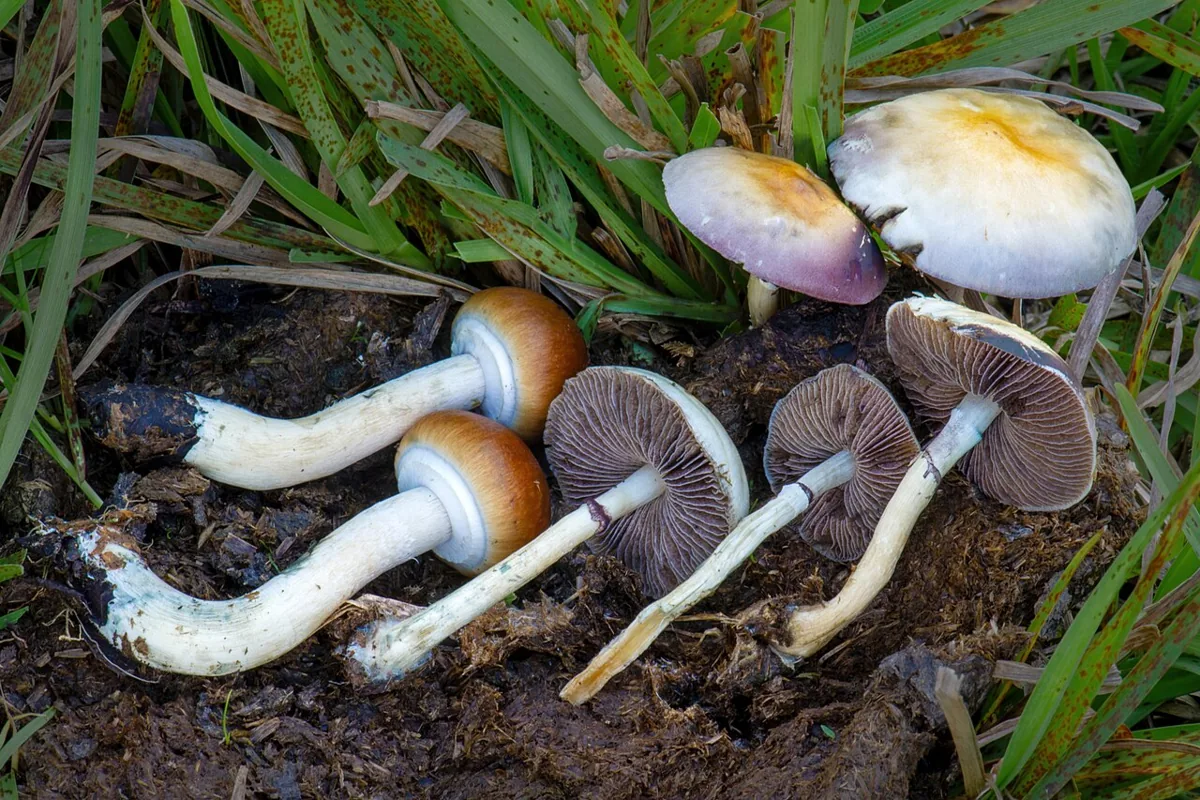
Psilocybe cubensis
Golden teacher
Large, ringed, dung-loving species and the most widely cultivated psilocybin mushroom.
Regional status: Introduced and naturalized in tropical and subtropical Australia
- Cap
- Convex flattening to 8 cm, golden brown to pale tan, paler at the margin, sticky when wet.
- Gills
- Adnate, pale grey turning dark violet-brown with a mottled look.
- Stem
- 40-150 mm, white, thick, with a persistent membranous ring that catches dark spores.
- Flesh
- White, bruising blue.
- Spore print
- Dark purple-brown
- Habitat
- Subtropical pasture, growing on and around cattle and water-buffalo dung.
- Distribution
- Gulf Coast of the USA, Mexico, Central and South America, Southeast Asia, Australia.
- Season
- Warm, humid months, especially after rain.
- Bruising
- Strong blue-green bruising on cap, stem and flesh.
- Odour
- Farinaceous.
- Potency
- Moderate
Key features
- ▪Persistent membranous ring stained purple-brown
- ▪Strong blue bruising
- ▪Grows on dung in warm climates
Field tests
- Spore print must be dark purple-brown
- Press the stem firmly and look for blue within minutes
Edibility
Contains psilocybin and psilocin.
Warning
Panaeolus and Protostropharia species share the dung habitat; some Conocybe on dung are deadly.
Lookalikes
Panaeolus antillarumharmless
Also on dung with black spores, but lacks the persistent membranous ring and shows no blue bruising.
Protostropharia semiglobataharmless
Same dung habitat and dark spore print, but the cap is sticky yellow and the flesh never bruises blue.
Photo and feature-based identification is probabilistic. Never consume a wild mushroom on the basis of an app result — confirm with an experienced mycologist.